BlogPost#6: Film Opening Research & Gender Theory
- Iris Li
- Dec 1, 2022
- 10 min read

Updated: Sep 10, 2023
Film opening is an integral part of its storytelling. It establishes the tone, the setting and introduces the central characters. It gives the viewers motivation to keep watching.
The Anatomy Of Story by John Truby:"The beginning of the scene should fame what the whole scene is about. The scene should then funnel down to a single point, with the most important word or line of dialogue stated last."
Thriller film opening analysis:
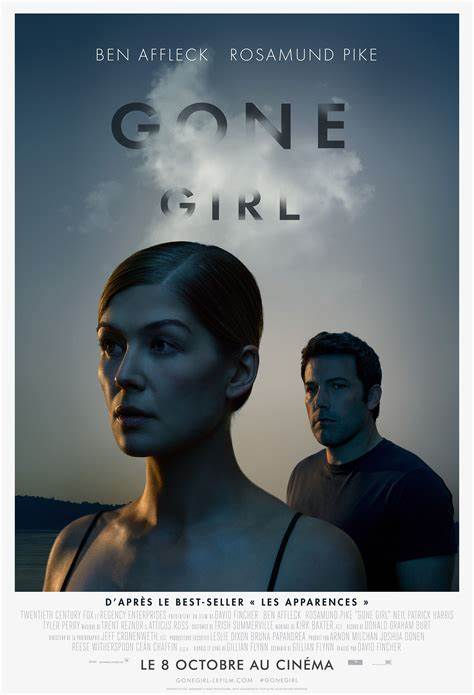
Film Title: Gone Girl
Film studio / distributor: 20th century fox & Regency
Screenplay&novel: Gillian Flynn
Year of Release: 2014
Director: David Fincher
Staring:
Gone girl film opening:
"Gone Girl" was directed by David Fincher, he used camera techniques, mise-en-scene, sound, and editing to present this psycho-noir thriller film.
At the start, the two film studios used a new relatable tone with this film instead of using their originally designed production logo. The idents have been silenced and the music is used as a sound bridge to lead into the film, which prepares excitement and suspense slowly for the audience at the start of the film.
The non-diegetic score throughout the opening was the key to setting up the suspense feeling which builds up the tension at the same time, intrigues audiences. The low tones and eerie instrumental music and echoing effects add to its strange, unnatural feeling. Usually, synchronized high-pitched music was used in Sci-fi, related to Aliens, which the audiences could infer as the key theme or point of this film, or arguably the odd within one's environment. The slow pace of the music also could be connoted as mirroring the slow-burning story. With an editing technique J-cut, in which the sound comes out first then the picture, the violent male monologue was introduced, saying about wants to crack the girl's head. At the same time, an extreme close-up shot gave off a blond beautiful girl, she was lying on a man’s body and looking up. Although the show was at an eye-line angle, the way the girl looks up gives the audience the feeling of being powerless, being a female victim. The repetition of the violent and thriller genre signaled at the beginning. Based on Neale’s genre theory, the character convention in this film are the male antagonist and female victim, they are the leaders of this thriller story, and the audience may expect the appearance of policies and detectives next. The narrative also hooks the viewers, since they did not expect the husband to say the weird violent monologue when he stroked his wife’s hair. However, within this scene, there was a difference that challenge the conventional thriller. The mise-en-scene, lighting was not following the conventional thriller setting, it was the dawn sunlight coming into the room through the window, morning as the beginning of the day represents a sense of happiness and hope, but in this case, it leaves an enigma to audiences. The girl in the frame also shows the main focus of this film, also connected to the title of the film, foreshadowing she was the girl who disappeared in this story.
After the first creepy scene, the director used those kinds of cranking noises, hostile bird chirping, and sea waves diegetic sound to balance the eerie, unwelcoming feeling the score gave at first. The title sequence started. With a fade transition, followed by a black background and fading title. The two main character’s name was introduced. The director only showed two main cast's names at the beginning and in the middle, symbolizing the importance of the two characters, also the assembly of marriage, only two are enough. The contrast between, the black background and the semantic codes in Semiotics by Barthes, conveys the deeper meaning, the audience could infer that the marriage was full of darkness and depression, portraying they were not in life for love, because the color black symbolizes death, and evil. The others' names were set at the bottom right or left, which connotes uncertainty, as there is no certainty in reality. The font of the titles fits the theme perfectly, the hard bold sans-serif gives a cold, emotionless feeling to the audience. The kerning was small, which could arguably suggest loneliness, the audience could infer that someone in this marriage was suffering the loneliness, as they are drifting apart. The texts slowly fade in and out linking to the initial theme of disappearance: "Gone". The title of the film appeared with the seashore at the center. The color of the font was pale yellow, as the new star or the beginning, in contrast to the dark, ominous blue background connotes a threat. The fading out and flashing transition of the canted/Dutch angle shots of the town also offers an atmosphere of unsteadiness and mystery, implying the town is in an abnormal and distorted situation. The opening ends up with the scene of the husband standing by the rubbish bins in front of their house. Usually, the focus will not give to the minor props, however, in this scene, the focus on both the rubbish bins and the husband implies that his life and his marriage were all messed up. The sneakers he wears also provide an idea of he wants to escape from his current situation.
Based on Semiotic by Barthes. While the composition of the character, the wife was lying on the husband’s body, the connotation of the pose, the proxemics between the character connotes their relationship, they are close enough that the audience could knowledge their relation; the wife's face was pale and white, not like she was in a sense of life. The color tone of the light was also cold, giving the sense of hopelessness, a somber tone. The binary opposition from Structuralism by Lévi-Strauss appeared several times. The contrast between loving and violent at the beginning builds up the tension in this story, and there was also the character opposition, angel vs. sinister. The blonde wife gives the audience a sense of innocent, purity, and naive. But the husband wears monotony and simple clothes, the dark expression showed his sinister quality. He was harmful and had unknown intentions. The contract between the two character helps to create compelling narratives, creates conflicts to hook audiences to engage; also create identifiable character types, and allows audiences quickly gain a sense of the direction of a story.
The film started with a sudden disequilibrium, so it doesn't follow the Narratology by Todorov, and there was no male hero in this story so it doesn't follow Propp’s seven character types. The film reflects the real world around us, according to Representation by Hall, The director flipped around the stereotype within this film, particularly the blonde.
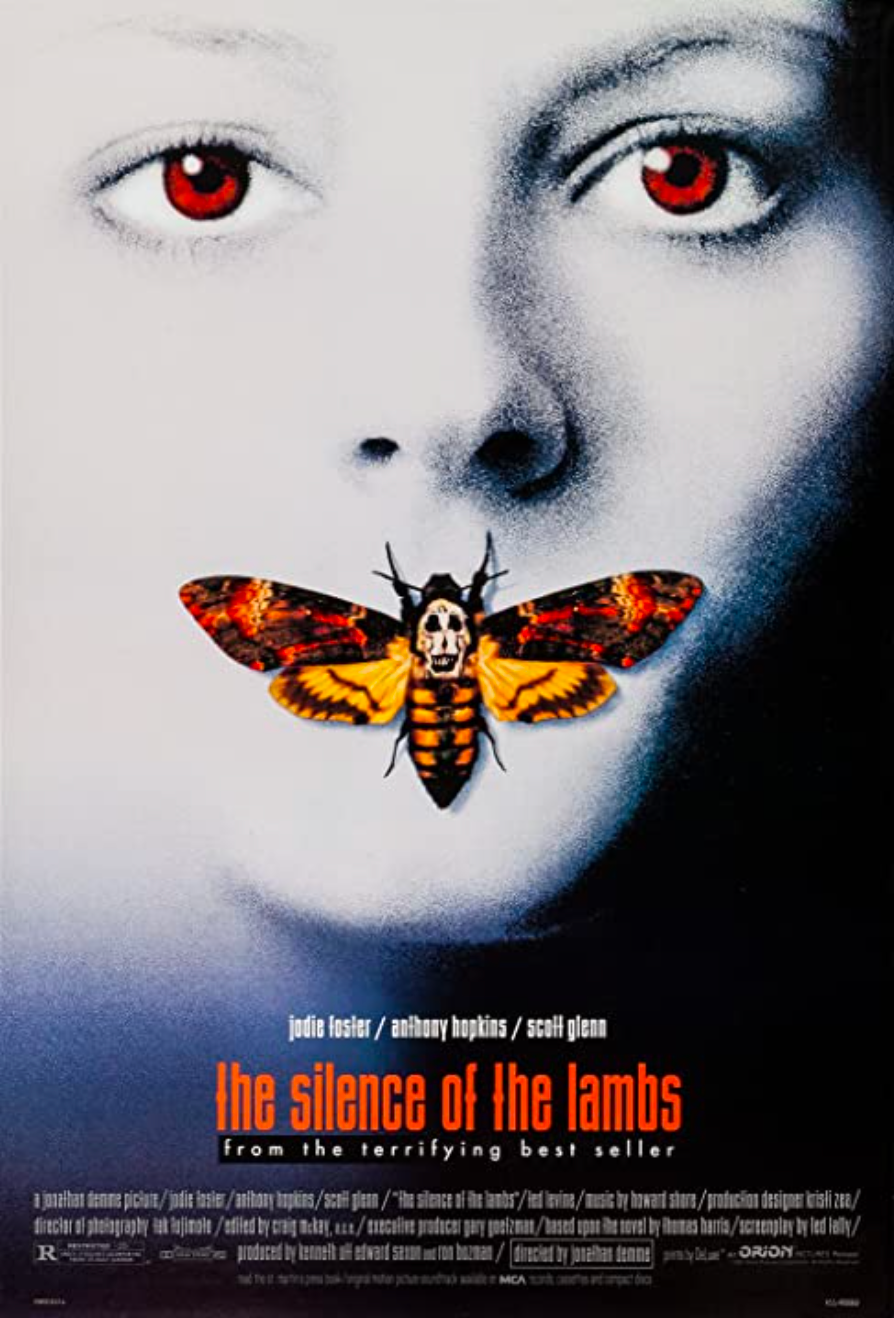
Title: The silence of the lambs
Film studio / distributor: Strong Heart/Demme Production & Orion Pictures
Novel by: Tomas Harris
Screenplay by: Ted Tally
Year of Release:1991
Director: Jonathan Demme
Staring:
Jodie Foster- Clarice Starling
Anthony Hopkins- Hannibal Lecter
Scott Glenn- Jack Crawford
Anthony Heald- Dr. Frederick Chilton
The silence of the lambs opening:
In the film opening of 'The Silence of the Lambs' the focus on the female and her power has introduced the combination of technique codes, audio codes, and symbolic codes.
The opening starts with a studio logo transited to an establishing shot of wood with naked trees without leaves, which is a stereotypical location for a horror film. The non-diegetic sound, score, was continued from the studio logo, a minor key orchestral, with a looping bass line. The purpose of the music was to create suspense feeling and build up tension among audiences. With a little diegetic sound, birds, and insects chirping, the quietness in the wood as an isolated area, could be seen as an insight of the protagonist. The camera then pans down to focus on a female in a sports uniform, sweaty and heavily breathing, using a rope to climb up the slope. The rope could symbolize someone’s help, portraying that she might grab an opportunity to climb up to the next step, and then she could finish her task by herself. While she was doing the obstacle course, the director used jump-cut and mid-close-up to trace the character. The use of jump-cut, the audience cannot see parts of the run that she was taking, makes the audience feel slightly on the edge, the feeling of she was running away from something. The female character running through the mist, and passing the climbing net, could convey the obstacle she needs to face within this film, as well as the four boards on the tree: "hurt, agony, pain, and love-it". Audiences could infer the mist is uncertain and mysterious. This suggests the difficulty of the character’s career path and how she would comfort with it. The wood scene ends up with an FBI faculty asking the female character, at this time the audience knows her name, Clarice to meet Mr.Crawford in the office. The director leaves an enigma code here, based on Barthes’s Semiotic, the enigma constructs moments of mystery to intrigue the audience, hook the audience and compel further viewing to locate answers to the questions posed. The enigma here is the question: why Mr.Crawford wants to talk to Clarice? What will they discuss?
Then comes the building scene. With the diegetic sound, gunshot, and helicopter sound, the audience could infer the place linked to the military, the sound underlying the theme of the film, law, and crime. The orchestra faded out when cut to the building. The tone of the building was the grey color scheme dull, giving the audience a false sense of security, there is no atmosphere of excitement. The lighting in the building was bright, which contradicts the conventional horror film, and creates a conflict. The camera follows Clarice’s step, there was a large male presence in the frame, together with male murmuring also indicates that there’s a gender stereotype of the job that Clarice takes. The binary opposition from structuralism by Levi-Strauss was used, Clarice stands in the middle and is crowded by males with red uniforms in the lift. She was small among the large males. This scene creates a conflict that audiences are more likely to engage with Clarice and her identifiable character type was also built, as she was not a conventional female character.
The final scene is Clarice at the office, talking to Mr.Crawford and the orchestral music lingers back to when they were talking. When Clarice looks at the newspaper board, when Mr.Crawford comes in, the director has used shallow focus, emphasizing that Clarice was focused on the cases and did not notice his presence of him, giving audiences the feeling of she concentrates on the cases. Mr.Crawford was wearing a double-breasted suit with golden rounded glasses, the prop and the make-up portray him as powerful, authoritative, much groomed, and neat, and suggests that he was in a high working position. When they were talking about Hannibal, the director used match-cut, allowing audiences to see the reaction to what has just been said, understanding fully intensity.
Clarice as the protagonist, she was wearing unique, which makes her stand out from the rest of the characters, all the males are in uniform which seems not to be significant, as they were all the same. This fulfilling their narrative function of creating a working environment for the film and also present Clarice as the important character in this film. Through using the costume, the director gives power to Clarice, as she is a unique person. Clarice's costume and make-up, compared to the typical female film, seems unglamorous, sweaty, and a little bit masculine, however, she was also wearing a pair of pearl earring, which could connote as she is strong outside but soft inside. She was not mature enough, still naive. According to Feminist theory by van Zoonen, this film, it did not limit the role that women play. Conversely, Clarice as a female plays a vital role in the film as the protagonist, they did not restrict females as the secondary role. Moreover, the film also did not objectify women through composition and costuming, the director constructs an independent, strong, smart female character, this could be connoted from the first scene, she has done the obstacle course alone, and works in a place with a large male presence. All of these, present Clarice as the female protagonist within this film.
The film opening I chose above, protagonists are both female, leading to next section in this blog post: Three Gender Theories, which is the area that I want to look in-depth.

Feminist Theory by Liesbet van Zoonen
Van Zoonen believes the media portray images of stereotypical women and this behaviour reinforces societal views. The media does this because they believe it reflects dominant social values (what people believe in) and male producers are influenced by this. This is a patriarchy (a society ran by men for men) which dominates and oppresses women.
1)In patriarchal culture, the way women’s bodies are represented as objects is different to the representation of male bodies as spectacle.
Women are objectified in the media.
objectification: seen women as something to be looked at, to be bought, to be sold, or something that doesn’t need to be seen as a person. As the possessions of men.
Some of the adverts don’t even have the women’s faces, as well as the poster, women were rescued by a male character, held by a male.
-All of these are because we live in a patriarchal culture, the objectification of women is because our society is dominated by men, so men may tend to be the ones who make the media products.
Patriarchal culture: the world is dominated by men.
-She believes that women and men were represented differently.
While she believes women are represented in objectification and sexualized, she believes men’s bodies are represented as "spectacle". That men’s bodies are represented as something that we should admire because of how they have achieved it, whereas women’s bodies are shown as something that we should lust over, and don’t necessarily give any credit to the woman for having that body(because we accept the view as women should have that perfect body), should be seen it as something that we want to buy or own.
Spectacle: men are seen as something spectacular, they are working hard to achieve something powerful. (Abs, muscular)
2)Gender is performative – Our ideas of femininity and masculinity are constructed in our performances of these roles. Gender is ‘what we do’ rather than ‘what we are’.
-People get ideas about gender from discourse, people learn what it is to be female or male from the media products that people consume.
Discourse: written and moving image communication from the media (e.g. tv programs, newspapers, stories, magazines, etc.)
Women are often represented in her view as being domestic, seen as homemakers (mother, wife, the person should do cleaning/cooking/laundry), emotional, and nurturing.
Men are often represented as an individual, suited to business and politics.
3)Gender is contextual – its meaning changes with cultural and historical contexts.
-Our ideas about gender construct in terms of the cultural and historical context.
(E.g. masculinity may differ from the 1950s to the present and feminine may have been very different from the 1920s to the present. The idea of masculinity and femininity in Britain may also have been very different in China.)
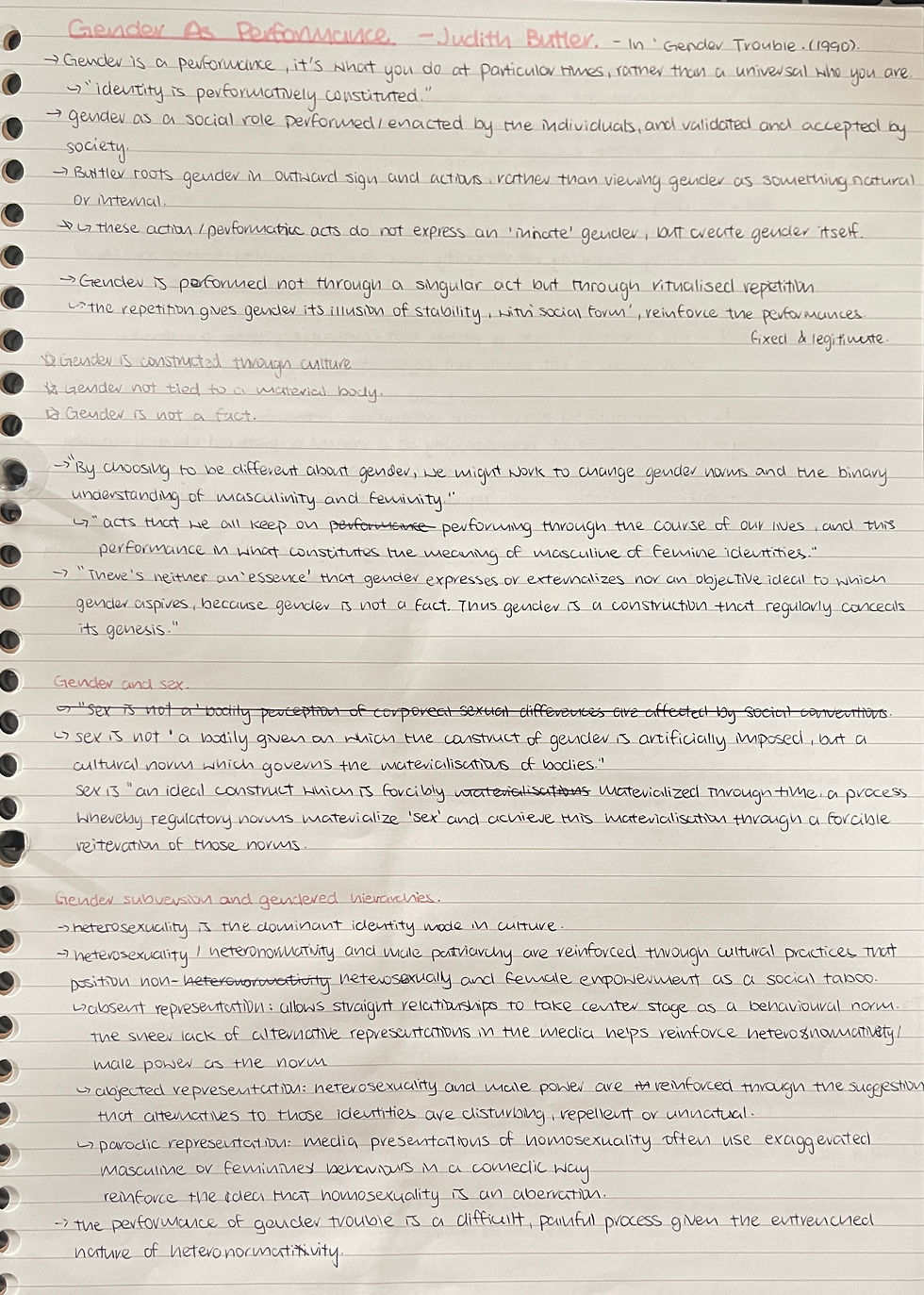
Gender as Performance by Judith Butler



Comments