BlogPost#3: The Narrative/Structure theories in films
- Iris Li
- Nov 19, 2022
- 9 min read

Updated: Jun 12, 2023
"The medium is the message... Impact is more important than medium itself."-McLuhan
In this Blog post, I will briefly introduce several theorists and their theories that related to the films:
Vladimir Propp- Morphology of the Folktale
Tzvetan Todorov- Narratology
Claude Lévi-Strauss- Structuralism
Roland Barthes- Semiotics
Vladimir Propp- Morphology of the Folktale (1929)

Propp extended the Russian Formalist study of language to his analysis of folk tales. He broke down the tales into the smallest possible units, which he called narratemes, or narrative functions, necessary for the narrative to exist. ach narrateme is an event that drives the narrative forward, possibly taking it in a different direction. He suggests the stories do not necessarily follow all the 31 narratemes, but those are relayed in strict linear fashion.
Although the plot is driven by the actions and choices of the hero (the protagonist), these narrative functions are spread between the main characters. Propp also defined these character categories:
The hero: the seeker-hero and the victim-hero, reacts to the donor and weds.
The villain: who struggles with the hero (a.k.a. the antagonist).
The donor: provides the hero with a magical agent that allows the hero to defeat the villain.
The helper: who accompanies the hero on their quest, saving and helping the hero to overcome the difficulties.
The Princess and a sought-for person (and/or her father): who exists as a goal and often recognizes and marries hero and/or punishes villain, the princess often represents the reward of the hero’s quest.
The dispatcher: who sends the hero on the quest (start of the story).
The false hero (or antihero or usurper): who claims to be the hero, often seeking and reacting like a real hero (ie by trying to marry the princess), usually umasked in the last act of a narrative.

Propp's work was translated into English in the 1950s, by which time it had become core to the ideas of theorists such as Claude Lévi-Strauss and Roland Barthes. Tzvetan Todorov was also deeply influenced by his theory.
Evaluation:
Although Prep’s lists are easy to learn, but it can not easily applied to every narrative films. Many of films are non-linear, which deliberately defy the conventions of traditional folk tales, because the world we live in is very sophisticated narratives. Not all narratives are about struggles between heroes and villains, many stories are not this simplify. Propp’s theory rely on 'good' and 'bad' characters, but many interesting narratives spring from a conflict between two characters who are not easily identified as a protagonist and an antagonist.
'The devil wears Prada', 'Breakfast at Tiffany's'... Lots of female films are not following Propp's theory, the female characters are not the 'princesses' but the 'hero'.
Tzvetan Todorov- Narratology (1969)
Todorov was hugely influenced by the Russian literary theorist Vladimir Propp and his highly influential 1929 book, Morphology of the folktale and proposed the narrative theory in 1969, he believes that this theory could applied to any film. He argued the “functions must be defined independently of the characters who are supposed to fulfil them” and these plot points usually occurred in the same order in the story.
Narrative refers to the techniques writers use to organise their stories into a clear and satisfying form which will appeal to the audience. This involves editing and sequencing events into a coherent structure. Writers also have to make decisions regarding how characters will be portrayed.
Todorov argued narrative was the movement from one balance to another. He suggests that all films followed by the same narrative pattern and went thought the five stages, including equilibrium, disequilibrium, acknowledgment, solving and again equilibrium.
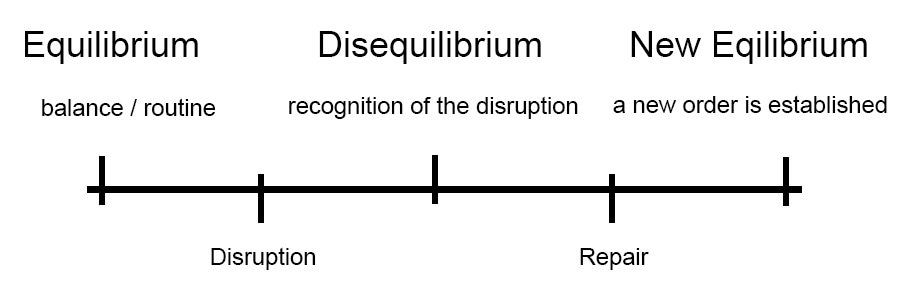
The five stages narrative pattern:
1) Equilibrium- A state of equilibrium (All is as it should be.)
A happy start of the story at the beginning of the film.
2) Disequilibrium- A disruption of that order by an event.
There is something of a problem disrupt the happiness.
3) Acknowledgement- A recognition that the disorder has occurred.
With every character realizes the problem and forms a chaos.
4) Solving- An attempt to repair the damage of the disruption.
Every character attempt to repair the damage and restore the problem.
5) New equilibrium- A return or restoration of a NEW equilibrium
The problem solved and normality can resume again, the characters learned and become mature from this case.
Even non-fiction texts can be influenced by the author's intentions, all media texts are constructed versions of reality. The way a narrative is presented has the power to influence the audience’s point of view towards people and places. Our interpretation of a scene/ a plot or things we receive are shaped by the creator/ the producer. The directors or creators could use a range of narrative strategies to get audiences’ attention, such as the use of enigma codes, to hook viewers and audiences. Basically, narrative codes are entertaining and help us make sense of the world.
Claude Lévi-Strauss- Structuralism

"Binary pairs, particularly binary opposites, form the basic structure of all human cultures, all human ways of thought, and all human signifying systems…"-Claude Lévi-Strauss
The basic concepts of Structuralism:
-All cultures are based on a series of binary oppositions;
-These oppositions are not static, but rather are constantly changing and evolving;
-Culture is best understood as a system of signs and symbols;
-All cultures are interrelated, and that our understanding of one culture can be enhanced by our understanding of others.
Binary oppositions:
Binary opposites are a pair of related concepts which are opposite in meaning
Each pair of ideas can only really be understood by their relationship to each other. The concept of “bravery” does not really make sense on its own because you need to be aware of its opposite, “cowardice”, for the word to gain its full meaning.
Claude Lévi-Strauss, believed binary opposites formed the “basic structure of all human cultures” and “all human ways of thought”. In terms of communication studies, he also said binary pairs were essential to “all human signifying structures”.
Media based:
Character oppositions: The construction of characters that are juxtaposed.
Narrative oppositions: Organized to construct moments of opposition.
Stylistic oppositions: The use of contrasting design elements.
Reinforce wider character-orientated oppositions or are deployed to create aesthetic interest.
Genre-driven oppositions: Paired elements that are commonly found in specific genres.
Deeply entrenched within genres that they become a convention or expectation of that genre.
Function of oppositions:
To clearly explain ideas, oppositions can reused to simplify viewpoints or make complicated ideas understandable for viewers and readers.
To create compelling narratives, the inclusion of binary oppositions inevitably creates conflict, making audiences more likely to engage.
To create identifiable character types. Audiences can quickly gain a sense of the direction of the story once they oppositional characters are introduced.
To create audience identification, prompting audiences to identify with one central character or viewpoint.
Evaluations:
Although the way we categorize the world into binary opposites might seem harmless at first, but their definitions are often shaped by a culture’s ideology so one concept is viewed as superior when compared to the other. According to Jacques Derrida, “one of the two terms governs the other”.
If media texts help to normalize certain views and attitudes, we need to critically assess the representation of binary opposites, especially if there is an imbalance of power or we reduce concepts to stereotypes.
Furthermore, critics argue that structuralism is a way of thinking about people and their minds. It doesn’t focus on how culture changes over time, which is problematic because it does not take into account how individuals act differently at different points in history. In fact, many anthropologists have criticized structuralism for its lack of concern with human individuality. Cultural relativists, in particular, criticize this perspective. The language is much more ambiguous than the theory suggests. They believe that structural “rationality” depicts human thought as being uniform and invariable.
Film Noir: The characters in noir films are in 'grey', nor black or white, there's no clearly contrast between good or bad, so noir film is one expectation of the binary opposition. For example: 'Brick', 'Joker', 'The lady from Shanghai'...
Roland Barthes- Semiotics, Mythologies (1957)
Saussure, in his 1916 Course in General Linguistics, divides the sign into two distinct components: the signifier ('sound-image') and the signified ('concept'). For Saussure, the signified and signifier are purely psychological: they are form rather than substance.

Roland Barthes was influenced by Saussure and he believed this relationship was part of a larger model of communication which he called the signification process. In Barthes’s later work, even actions become mediated by language. Every act is at once an act (signified) and a sign of itself (signifier). It becomes hard to unpack the act from its meaning.
Signifier: any material thing that signifies, e.g., words on a page, a facial expression, an image.
Signified: the concept that a signifier refers to. (A real thing or, in a stricter reading, a sense-impression).
The signified sometimes has an existence outside language and social construction, but the signifier does not.
The signifier and signified make up the sign theory:
Sign theory
A sign, in this context, refers to something which conveys meaning. All signs depend on the entire system of signs. None of them have meaning aside from the system.
Denotation: the literal or explicit interpretation of the sign, such as the dictionary definition of a word or a photograph represents the person in the shot.
Connotation: an additional meaning which usually expresses an emotion or a value. E.g.: Red-Blood, passion, suspense. Here, the denotation is the physical form of the color. The icon of the person is another denotation.
Roland Barthes argued signifiers could be grouped into five narrative codes that “weave” together to form the story. Therefore, he produced his Five Code Symphony:
When a writer deliberately withholds information from the audience to leave a plot point unexplained, they are using a Hermeneutic code, also known as Enigmas codes. We are left to form our own interpretation of the event or question how it might be resolved later in the story. This narrative technique is used by mystery writers who want the reader to keep on guessing who committed the crime until the final reveal at the end of the story.
Proairetic codes (actions codes) are plot points which are caused by previous events and lead to other actions. Writers create a pleasing sort of tension by making the audience wonder how the event will be resolved. The narratives also offer moments in which meaning is conveyed through action or demonstration, actions provides explanation or excitements.
Barthes argued some codes had “flickers of meaning” in the text. Rather than simply working on a denotational level, these signs carried connotations beyond their basic definition and gave the reader a little more insight to the characters, setting and plot, which is the Semantic codes or connotative elements. This including lighting mise-en-scène and color usage, they also refer to the use of compositional effects.
Symbolic codes are best defined as thematic or structural devices. Barthes suggested symbolic codes are a “battle” between contrasting signs. When they are placed together in a story, the binary opposites help emphasize the difference between whatever characters or setting are being represented. It is the writer’s deliberate use of antithesis that elevates the signs to symbolic codes. Some signs might also recur throughout the text, but our interpretation of their meaning gradually shifts so they become symbolic codes.
The last one, Cultural codes(referential codes), refers to the inclusion material that generates meaning form outside the product.Many stories allude to concepts and ideas that exist outside the text. In order for these signifiers to be decoded fully by the audience, that information needs to be part of our framework of knowledge. These cultural codes include historical, social, psychological or literary references.
However, some signs are used to represent a more complex concept, such as the shared values and ideologies of a particular culture or group. This is the second order of meaning, or signification, which Barthes called Myth. Myths are allegorical, they present moral outlooks and tell us how we ought to behave. Media has replaced the functions of traditional myth making.
Barthes called the first order language and the wider, cultural meaning the myth.

The ideological effects of media consumptions:
Naturalization, the process of making ideas or viewpoints feel like they are common sense when, in really, they are constructed or manufactured by media producers.
Media texts repeat the same idea enough times audiences come to believe that those ideas are not a matter of perspective , but an immutable social norm.
Media myths are reductive, the use of simplicity creates audience appeal, and also has the effect of de-intellectualizing and depoliticizing ideas.
Media myths reinforce existing social power structures, those who have power tend to control the myth-making process, either owning or indirectly channeling media content through privileged access arrangements.
-Why do you think audiences might respond well to particular narrative structures?
Audiences are hooked and intrigued by the narratemes, they tend to follow the character with their journey in the films.
The linear structure of stories invokes audiences’ desire, and the lead character takes the journey and motivated the viewers to follow them. Viewers and audiences tend to replace themselves in the real world.
-Why do some directors/writers challenge the structures and what effect can it have?
In 'Pulp Fiction', the director did not follow the structures. The director told the story non-linear, which makes the film interesting. Because some of the elements at the end of the sub-section have an effect on intriguing audiences (The enigma codes), such as Jules and Vincent wearing the American retro holiday style dress when they went to visit the big man, before that, they were wearing the black suits, which creates unknown information for audiences.
In the film 'Saw', binary opposition has been used in the opening.


The dark and bright; Calm and distorted; live and dead; experienced and inexperienced.
The reaction between Adam and the doctor was a contrast. While Adam was screaming and yelling in the dirty bathroom, the doctor was calmly thinking about what was going on there and trying to make Adam calm down too. There was a bloody dead body between them, which present the contrast between the dead and the life. This theory created an effect of presenting the characters and their relationship throughout. The binary opposition within the film's opening infers the difference between them and keeps intriguing the viewers to keep watching the following scenes. With the narrative theory, I could understand more about the characters, such as their personalities, their attitude toward the issues, etc.
Propp’s theory did not appear in this film opening, because there are no seven character types within this clip, but there was a disequilibrium going on at the film opening: a dirty unknown bathroom, two characters being trapped there with a bloody dead man.


Barthes’s five codes symphony has been used. The use of action codes: the tape, the key, and the brand-new clock on the wall, provides excitement for audiences and constructed proairetic moments, allows audiences to keep asking questions: what's in the tape, why the clock is there in the dirty bathroom? They also used the enigmas codes at the very beginning, when Adam was sunk under the water in the bathroom, this scene hooked audiences, letting


Comments